Prop Firm Trading Strategy How to Choose and Succeed with the Best Approach
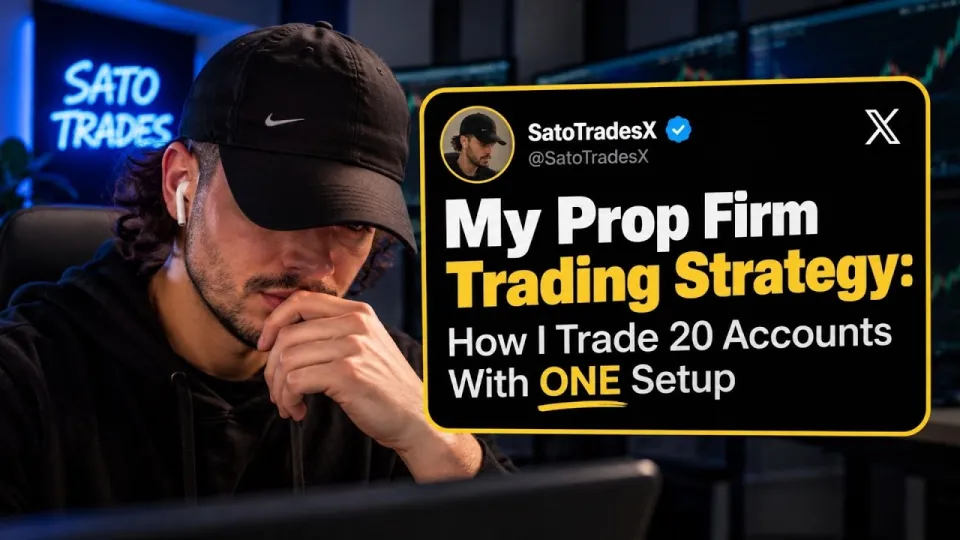
Video: Prop Firm Trading Strategy: How to Pass a Funded Challenge in 2026
· based on the channel Sato Trades
Key takeaways
- Use a mechanical trading system based on 1-minute futures charts
- Focus on key ES & NQ daily and intraday levels for entries
- Apply strict risk management with predefined stop loss and take profit
- Trade only during favorable market structure conditions to avoid losses
- Scale your funded account through multiple prop firm accounts
Prop firm trading strategy is essential for passing funded challenges consistently and securing payouts. A solid approach involves using precise mechanical trading rules, focusing on futures markets like ES (E-mini S&P 500) and NQ (E-mini Nasdaq), and managing risk effectively. For traders aiming to succeed in 2026, combining daily levels analysis with intraday price action on the 1-minute chart offers a reliable edge. To get started with this strategy, you can access daily ES & NQ trading levels and tutorials at Sato VIP.
Key Components of a Prop Firm Trading Strategy
A prop firm trading strategy must be mechanical and rule-based to meet the strict evaluation criteria of prop firms. The core components include:
- Daily and Intraday Levels: Identify high-probability support and resistance zones using daily ES & NQ levels combined with intraday levels for potential long and short entries.
- Mechanical Entry and Exit Rules: Use the 1-minute chart to pinpoint precise entry points aligned with confluence zones and market structure.
- Risk Management: Set fixed stop loss and take profit orders before entering trades to protect your funded account from large drawdowns.
- Market Structure Awareness: Avoid trading when the market structure signals uncertainty or adverse conditions.
- Scaling Accounts: Use multiple prop firm accounts and trade copiers to scale your profits after passing the initial evaluation.
How to Use Daily and Intraday Levels for Futures Trading
Daily levels for ES and NQ futures are mapped on TradingView to highlight key zones where price tends to react. These levels include high timeframe support and resistance and intraday potential reversal points.
Steps to apply levels:
- Mark daily and high timeframe levels clearly on your chart.
- Group and hide levels to avoid clutter.
- Watch price action near these zones on the 1-minute chart for entry signals.
- Confirm trade setups with confluence factors like volume spikes or candlestick patterns.
This method helps traders pinpoint low-risk entries suitable for mechanical trading.
Mechanical Trading System and Risk Rules
A mechanical trading system removes emotional decision-making. In this strategy:
- Use limit orders to enter at precise price levels.
- Always place stop loss and take profit orders simultaneously.
- Do not adjust stop losses once set; let the system work.
- Risk a small fixed percentage of your account per trade, typically 0.5% or less.
- Trade only setups that conform to your predefined rules.
These rules help protect your funded account, a critical requirement for passing prop firm challenges.
Managing Market Structure and When Not to Trade
Understanding market structure is vital to avoid losing trades during unfavorable conditions.
Avoid trading when:
- Price is consolidating without clear direction.
- Key levels are broken without confirmation.
- Momentum indicators signal weakness.
Trading only when the market shows clear trending or reversal patterns improves your win rate and reduces drawdowns.
Scaling Your Prop Firm Account with Multiple Accounts
After passing the evaluation, you can increase profits by trading multiple funded accounts simultaneously.
- Use trade copiers like Tradovate with a reliable copier service.
- Manage risk separately for each account.
- Gradually increase position size or number of accounts as confidence and capital grow.
This approach helps compound gains while staying within prop firm risk limits.
Dealing with Common Challenges in Prop Firm Trading
Common questions traders face include how to mark levels effectively, manage emotions, and choose the right prop firms.
- Mark levels using TradingView grouping features to keep charts clean.
- Treat prop firm trading professionally with discipline and patience.
- Compare prop firms carefully; Sato Trades offers a full guide highlighting the best futures prop firms.
Useful Links
- Daily ES & NQ levels and tutorials: https://satotrades.com/vip
- Best futures prop firms guide: https://satotrades.com/guides/best-futures-prop-firms
- Free Discord for daily level discussion: https://discord.gg/Yt5PuQjXRp
- Trade copier used by Sato: https://portal.tradecopia.com/signup?via=SATO
Итог
A successful prop firm trading strategy in 2026 relies on mechanical trading systems focused on futures markets, especially ES and NQ, combined with strict risk management and market structure awareness. Using daily and intraday levels on the 1-minute chart provides precise entries critical for passing evaluation phases and securing payouts. Scaling profits through multiple accounts further enhances growth potential. This comprehensive approach, detailed by Sato Trades, transforms prop firm trading into a professional, repeatable process. To get detailed levels and ongoing support, consider joining Sato VIP.
Source: Prop Firm Trading Strategy: How to Pass a Funded Challenge in 2026 · Markdown version
Questions & answers
What is a mechanical trading system in prop firm trading?
A mechanical trading system is a rule-based approach that defines precise entry, exit, stop loss, and take profit rules to remove emotional decisions. It is essential for consistent performance and passing prop firm challenges.
How do daily and intraday levels help in futures trading?
Daily and intraday levels identify key support and resistance zones on futures charts. Trading near these levels on short timeframes like 1-minute charts helps traders find high-probability entries and improve accuracy.
Why is risk management crucial in prop firm challenges?
Risk management protects your funded account by limiting losses through fixed stop losses and position sizing. Prop firms have strict rules on drawdowns, so managing risk is vital to pass evaluations and stay funded.
Can I trade multiple prop firm accounts to increase profits?
Yes, after passing evaluation, many traders use trade copiers to manage multiple funded accounts simultaneously. This scaling strategy helps grow profits while adhering to prop firm risk guidelines.